|
|
Scientific hand reading: explore the significance
of the 9 minor levels of the hand!
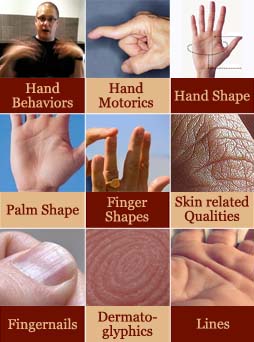
• Level 1: HAND BEHAVIORS
• Level 2: HAND MOTORICS
• Level 3: HAND SHAPE
• Level 4: PALM SHAPE
• Level 5: FINGER SHAPES
• Level 6: SKIN RELATED QUALITIES
• Level 7: FINGERNAILS
• Level 8: DERMATOGLYPHICS (& FINGERPRINTS)
• Level 9: (MAJOR) LINES
Discover more about hands:
• Hand Reading Research
• Hand Reading Forum
• Palm Reading Guide
• Hand Reflexology
Multi-Perspective Palm Reading is about combining (statistically) validated hand sign combinations; additonally, the following two Modern Hand Reading guidelines are recommended:
GUIDELINE 1: "Modern hand reading starts with a quest for hand sign combinations;
isolated hand signs represent hardly any significance."
GUIDELINE 2: "Proper hand assessment nearly always requires
a 'multi-perspective' approach, involving multiple levels of the hand."
• Palm Reading Lines
• Reflexology Charts
|
|

What is Multi-Perspective Palm Reading?
In Multi-Perspective Palm Reading the hand is described to represent a system involving 5 major perspectives, which together describe how 'structure' and 'function' represent complementary phenomena. Additionally, these 5 major perspectives of the hand are sub-divided in 9 minor levels which are being used to describe the significance of hand signs for individual themes. A high standard is set with two basic rules which describe how: (1) combinations of significant hand signs for every theme are required to relate to at least 4 out of the 5 major perspectives, and (2) for individual themes an additional requirement is set which relates to at least 1 specific level out of the 9 minor levels.
During the 20th and 21th century the global (academic) scientific community produced countless of reports where hands are being described to represent either a diagnostic instrument, or to represent a tool that is used investigate the etiology of various 'themes', such as: syndromes, diseases & personality related features.
However, the significance of individual hand signs becomes usually manifest in multiple themes; the significance of individual hand signs also tends to vary for every single theme.
In 2011 Multi-Perspective Palm Reading was presented as a new diagnostic-concept serving the purpose to describe guidelines for how to make a (reliable) diagnostic-assessment for specific themes.
In 2014 the guidelines have been updated, and 2 basic rules were derived from the findings which have been reported so far for 8 individual themes, including:
Down syndrome, Fragile-X syndrome, diabetes-mellitus (type 1 & 2), psoriasis,
rheumatoid arthritis, schizophrenia & the Big Five personality dimension Extraversion.
Multi-Perspective Palm Reading defined:
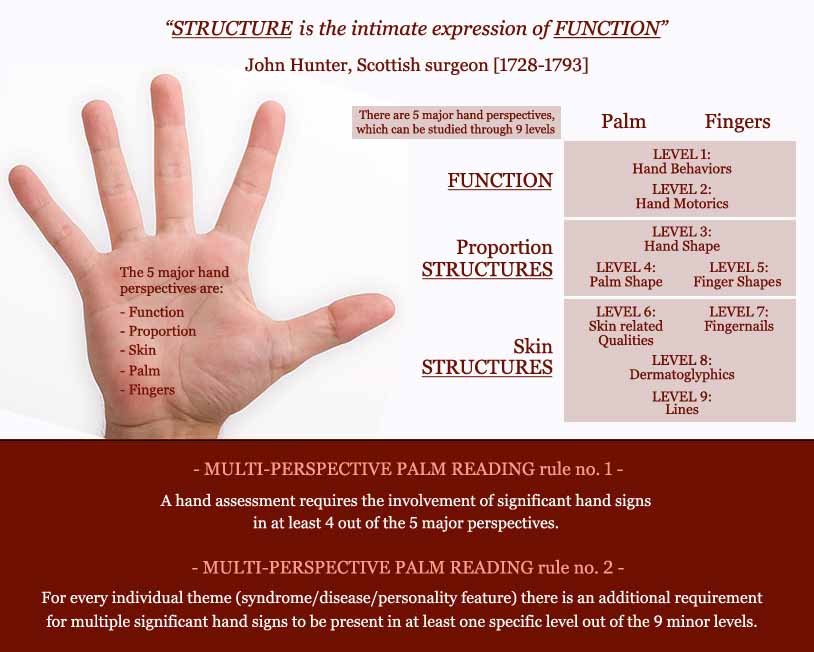
The essential key-element in Multi-Perspective Palm Reading is described by two basic rules (see also the hand chart above):
• Rule no.1: A hand assessment requires the involvement of significant hand signs in at least 4 out of the 5 major perspectives.
[NOTICE: The first rule underlines that the hand is required to be taken in consideration as a complete system in order to make a thorough hand diagnosis (diagnostic-assessment); the 5 major levels of the hand are represented by: function, proportion, skin, palm & fingers]
• Rule no.2: For every individual theme (syndrome/disease/personality feature) there is an additional requirement for multiple significant hand signs to be present in at least one specific level out of the 9 minor levels.
[NOTICE: The second rule underlines that for every individual theme a specific approach is necessarily required; the 9 minor levels of the hand concern: behaviors, motorics, hand shape, palm shape, finger shapes, skin quality, fingernails, dermatoglyphics & lines]
Explore the Multi-Perspective Palm Reading themes
+ find detailed background info:
• Multi-Perspective Palm Reading themes + background info
|


|
|
Multi-Perspective Hand Reading provides a deep reflection & understanding of how hand structure correlates with hand function.
Even though the hand is recognized to represent the most differentiated body part, this intimate connection is usually not highlighted in so-called 'philosophic systems' of hand reading (and hand reflexology) - where associative pseudo-research sort of became the standard.
Meanwhile, the significance of proper scientific research is usually undervalued in the fields of practical hand reading. And intuitive association gets over-valued due to little interest in the psychological mechanisms that easily get involved, such as the so-called 'Forer-effect' (a.k.a. the Barnum-effect) and apophenia (the spontaneous perception of connections and meaningfulness of unrelated phenomen) - which both also play a significant role in the cultural believes related to luck & gambling, and paranormal & occult experiences.
Related synonyms:
Scientific hand reading, hand analysis, palm reading, palmistry, chirology, chirognomy, chiromancy
|
|


 |
|

